Flowtriq: Building Low-Latency DDoS Defense via Edge-Based Intelligence
Most cybersecurity platforms suffer from "latency bloat"—the more sophisticated the detection, the slower the response. In the high-stakes environment of v...
By Dr. Amina Rahman, Markets Correspondent
27 March 2026
The Fallacy of the Perimeter: Why Modern DDoS Defense is Moving to the NIC
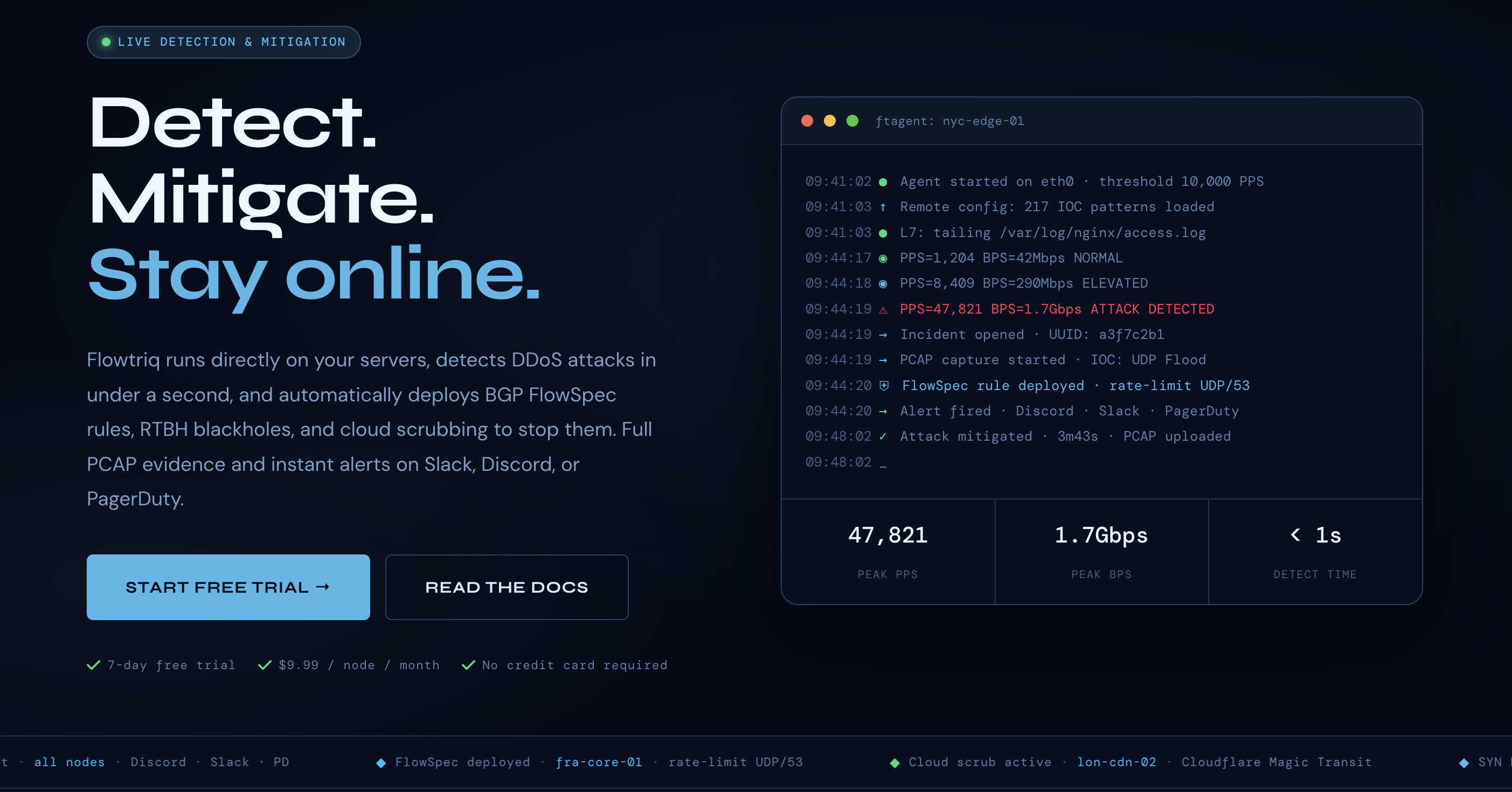
Most cybersecurity platforms suffer from "latency bloat"—the more sophisticated the detection, the slower the response. In the high-stakes environment of venture-backed infrastructure, the traditional approach of routing traffic through a distant scrubbing center adds unacceptable milliseconds of latency before a single packet is dropped. Flowtriq disrupts this paradigm by moving the intelligence directly to the edge. It is an agent-based, real-time detection and auto-mitigation platform designed for the sub-second demands of ISPs, gaming studios, and SaaS providers. Built on a lightweight Python-based architecture (ftagent), it bypasses the need for manual threshold tuning by utilizing dynamic baseline learning. Our analysis suggests that while most incumbents focus on "absorbing" the blow, Flowtriq focuses on the algorithmic surgical strike, identifying and neutralizing vectors in under 1,000 milliseconds.
Decentralized Intelligence: The Architecture of ftagent
Flowtriq’s architectural philosophy rests on a "Local Sense, Global Orchestrate" model. The ftagent is not a mere telemetry exporter; it is a packet-level observer that reads directly from the Network Interface Card (NIC). By operating at the Linux kernel level, the agent performs Packets Per Second (PPS) checks every single second, a granularity rarely seen in standard SNMP-based monitoring tools.
This decentralized approach solves the scalability bottleneck inherent in centralized monitoring. Each node independently evaluates its traffic against a locally learned baseline. When an anomaly is detected, the agent doesn't just scream for help; it executes pre-configured escalation policies. These can range from local iptables or nftables drops to sophisticated BGP FlowSpec injections and RTBH (Remote Triggered Black Hole) triggers. The control plane, hosted in the Flowtriq cloud, acts as the central nervous system for multi-node management and forensic storage, but the "kill switch" remains distributed at the edge.
Feature Breakdown
Core Capabilities
- Sub-Second Multi-Vector Classification: Flowtriq identifies over eight distinct attack types, including SYN floods, UDP amplification, and complex Layer 7 application attacks. By analyzing packet headers in real-time, it can distinguish between a legitimate traffic spike and a Mirai-variant botnet attack, ensuring that mitigation doesn't result in self-inflicted downtime.
- Dynamic Baseline Learning: Unlike legacy systems that require manual PPS/BPS thresholding, Flowtriq’s engine observes normal operational patterns to set its own triggers. This is critical for startups with fluctuating traffic; the system adapts as the "normal" ceiling rises, reducing false positives that plague static setups.
- Automated Forensic PCAP Capture: Upon detection, the system automatically triggers a full PCAP (Packet Capture). This provides infrastructure teams with an immediate "black box" recording of the attack, allowing for post-mortem analysis and IOC (Indicator of Compromise) extraction without needing to manually reproduce the conditions.
Integration Ecosystem
The platform is designed for the modern DevOps stack, moving beyond simple dashboard alerts. Flowtriq supports a robust selection of outbound integrations including PagerDuty, OpsGenie, Slack, and Discord. For automated remediation, its ability to interface with cloud scrubbing giants like Cloudflare Magic Transit, OVH VAC, and Hetzner is a significant value-add. This allows a "tiered" defense: handle small attacks locally via FlowSpec, and programmatically shift to cloud scrubbing only when the volumetric threshold threatens the uplink capacity.
Security & Compliance
Flowtriq maintains a high bar for data integrity through an immutable audit log, ensuring that every mitigation action and configuration change is recorded for compliance. Their research-heavy approach—highlighted by their discovery of the Mirai botnet kill switch (CVE-2024-45163)—demonstrates a commitment to proactive threat intelligence. For enterprise clients, the platform offers custom IOC libraries and extended 365-day PCAP retention, satisfying rigorous forensic and regulatory requirements.
Performance Considerations
The ftagent is remarkably lean, designed to run on Linux servers without cannibalizing the CPU cycles needed for the primary application. Because it reads from the NIC and processes locally, the resource overhead is negligible compared to the protection it provides. The sub-second detection-to-mitigation pipeline ensures that the "Time to Mitigate" (TTM) is lower than the "Time to Impact," effectively neutralizing the attack before the application's connection pool is exhausted.
How It Compares Technically
In the venture landscape, we evaluate tools based on their "Time to Value" and technical depth. Flowtriq competes in a space dominated by heavyweights, but its lightweight, agent-first approach sets it apart:
- Compared to Cloudflare: While Cloudflare offers world-class global scrubbing, it often acts as a "black box." Flowtriq provides deeper visibility into the specific packet-level vectors hitting your origin.
- Compared to Akamai: Flowtriq’s $9.99/node pricing and 2-minute setup time contrast sharply with the high-touch, high-cost enterprise onboarding of legacy providers.
- Compared to Fastly: Flowtriq's focus on BGP FlowSpec and RTBH for infrastructure-level protection complements Fastly's edge-compute strengths.
Developer Experience
The "two-minute install" isn't just marketing fluff; the Python-based agent is designed for rapid deployment via standard configuration management tools like Ansible or Terraform. The documentation is refreshingly technical, eschewing jargon for practical implementation guides. Furthermore, Flowtriq’s library of free tools—including an iptables generator and BGP FlowSpec builder—fosters a community of "infrastructure-first" developers who prioritize transparency and control over automated "magic" fixes.
Technical Verdict
Flowtriq is an ideal solution for startups and infrastructure providers who have outgrown basic rate-limiting but aren't ready for the five-figure monthly commitments of enterprise scrubbing contracts. Its strength lies in its granularity and speed; the ability to trigger a BGP FlowSpec rule in under a second is a game-changer for game servers and fintech platforms where every millisecond of packet loss equates to lost revenue. While it requires a Linux-based environment, its lack of traffic surcharges makes it one of the most cost-predictable security assets in a founder's arsenal. For teams managing edge nodes or high-throughput SaaS, Flowtriq offers a sophisticated, data-driven shield that finally makes sub-second mitigation accessible.
Further Reading
Visit Flowtriq →