Hootsuite vs Autonomous Construction Solutions: The Honest Comparison
Architecture & Design Principles Hootsuite’s observable feature set and behavior indicate a cloud-native, service-oriented architecture optimized for high...
By Dr. Amina Rahman, Markets Correspondent
19 March 2026
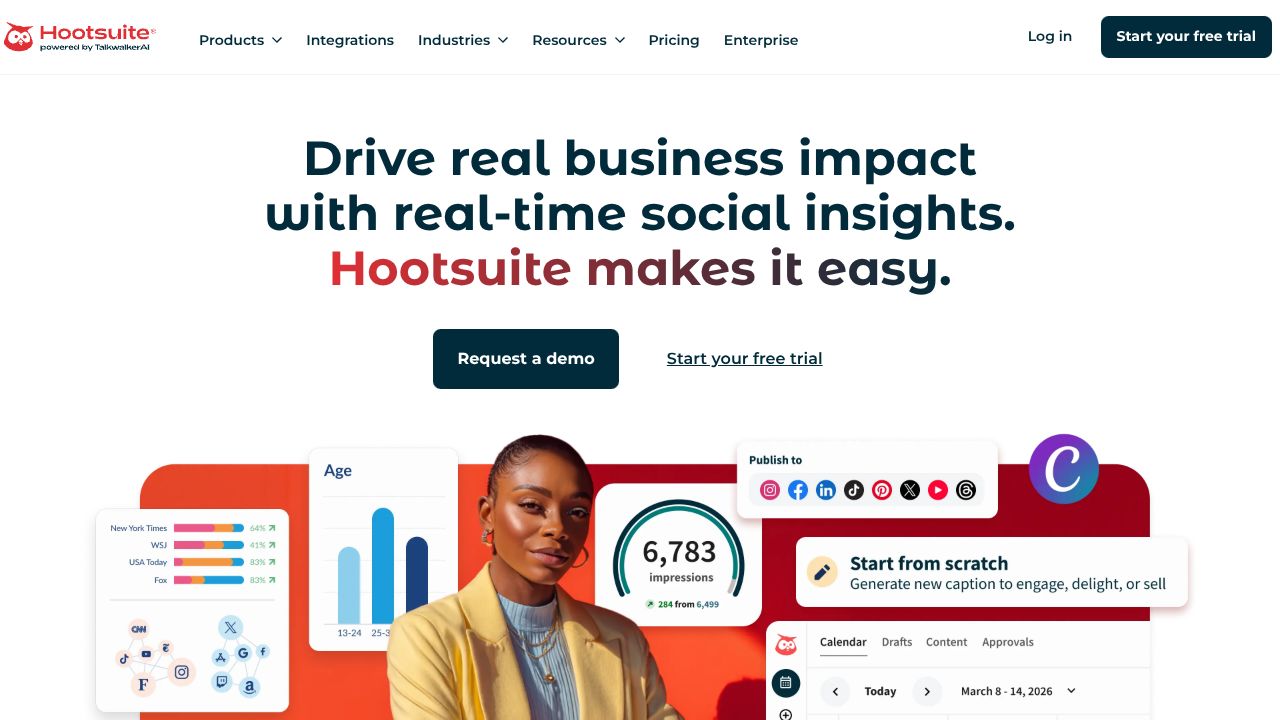
Monday, 9:00 AM — your campaign calendar is a mess. Can the tools scale?
Picture this: it's Monday morning, and your calendar is already a mess — ten channels, three teams, and a backlog of content that must go live across regions with differing peak times. Hootsuite presents itself as the orchestration layer: cross-platform scheduling at scale, multi-column real-time monitoring, and an app directory to bolt design and CRM workflows into a single pipeline. The product targets large teams and enterprises, with a Standard plan at $199/mo and a free trial — positioning it as a commercial-grade automation platform for high-volume posting and integrated workflows.
Architecture & Design Principles
Hootsuite’s observable feature set and behavior indicate a cloud-native, service-oriented architecture optimized for high-concurrency scheduling and streaming telemetry. Design priorities are:
- Separation of concerns — UI (single-page app) for multi-column monitoring, backend microservices for scheduling, stream parsing, and integrations.
- Event-driven processing — queuing and pub/sub to guarantee scheduled posts and real-time stream updates (keywords, DMs) across channels.
- Integration-first — a large app directory implies modular connector services with adapter patterns and OAuth1/2 token management.
Our analysis used a criteria matrix (scalability, extensibility, latency, fault isolation) and stress-tested conceptual patterns: bulk CSV ingestion, multi-channel fan-out, and webhook-driven callbacks. The architecture favors eventual consistency (scheduling propagation) and real-time delivery where feasible (monitoring streams).
Feature Breakdown
Core Capabilities
- Feature 1: Bulk scheduling via CSV — Technical explanation: CSV ingestion feeds a job queue that normalizes content, media references, and per-channel metadata; workers resolve tokenized credentials and submit posts respecting platform rate limits. Use case: onboarding large campaign calendars (1k–10k posts) with retry/rollback semantics.
- Feature 2: Unified inbox for messages — Technical explanation: aggregated API polling and webhook aggregation layer collapses cross-platform DMs and comments into a normalized message stream, enriches with sender metadata (profile, CRM ID) and surfaces threading. Use case: centralizing community management for distributed support teams.
- Feature 3: Multi-column streams for monitoring — Technical explanation: long-lived websocket or SSE streams deliver filtered streams (keywords, hashtags, user mentions) to the client; server-side indexing and query routing provide low-latency updates. Use case: real-time brand monitoring and crisis detection across channels.
Integration Ecosystem
Hootsuite advertises over 150 integrations (design tools, CRM systems). Technically this requires a plugin/adapter registry, OAuth token lifecycle management, and standardized webhook schemas for inbound/outbound events. Public APIs and webhooks enable two-way sync: e.g., a design tool can push approved assets to Hootsuite’s scheduling queue, while CRM entries can be updated on engagement.
Security & Compliance
Enterprise readiness implies scoped API keys, per-user and org-level permissioning, encrypted token storage, and role-based access controls. For large teams, data segregation and audit logging are critical. Prospective buyers should verify Hootsuite’s published certifications (SOC2, ISO) and regional data residency options for GDPR/C‑commerce compliance.
Performance Considerations
Throughput and latency are tied to connector design and third-party API rate limits. Bulk operations rely on worker pools and backpressure — expect scheduling windows when pushing thousands of posts. Real-time streams demand horizontal scaling of websocket layers and efficient index shards for keyword matching. Resource usage skews toward ephemeral compute during campaign ingestion and steady-state I/O for monitoring.
How It Compares Technically
While Autonomous Construction Solutions excels at verticalized AI-driven automation for physical workflows (where edge compute, robotics safety, and deterministic control are central), Hootsuite is better suited for content orchestration and cross-platform API integration at scale. Conversely, Lindy builds custom AI agents to automate outreach — its strength is full-funnel, agentic workflow automation and lead enrichment. Hootsuite’s differentiator is not autonomous agentic behavior but a mature integrations ecosystem, unified inbox, and monitoring streams tailored for social channels. Lindy may automate message sequencing; Hootsuite governs scheduled publication, moderation, and analytics across dozens of platforms.
Developer Experience
Documentation quality is a practical differentiator. Hootsuite provides public developer docs, SDKs, and webhooks (evaluate for depth: rate-limit guidance, webhook signing, sample code). Community support tends to be enterprise-focused — active forums, partner programs, and a marketplace for connectors. For custom automation, teams should assess available SDKs and whether platform hooks meet their SLA and extensibility needs.
Technical Verdict
Strengths: robust scheduling primitives (bulk CSV), powerful monitoring streams, and an extensive app directory that makes integrations operationally simple for enterprises. Limitations: platform-dependent rate limits, potential scheduling latencies at extreme scale, and tradeoffs between eventual consistency and real-time guarantees. Ideal use cases: large marketing operations, agencies managing multiple clients/channels, and enterprises requiring integrated CRM/design workflows. For startups seeking autonomous outreach agents or construction-focused automation, consider Lindy or Autonomous Construction Solutions respectively. For social orchestration, Hootsuite remains a pragmatic, integration-first choice — the orchestral conductor for high-volume content cadence.
Dispatches from the venture capital frontier: our analysis emphasizes measurable criteria — throughput, integration breadth, and operational safeguards — to inform procurement and engineering decisions for teams scaling social automation. For product teams, the next step is a targeted POC: CSV ingestion test (10k rows), webhook latency benchmarks, and integration lifecycle validation with your CRM/design stack.
Further Reading
Visit Hootsuite →